

Exhibition
Mindful Nature
by Pongsiri Kiddee, Mukdarasm Khampa
CURATORIAL STATEMENT (EN)
Mindful Nature
Mindful Nature carries two meanings at once: attention turned toward the natural world, and the nature of mind on which that attention rests — what Mukdarasm Khampa calls sapawa thammachat khong jai, the natural state of the heart-mind. The exhibition sits where these two meanings overlap.
Mukdarasm Khampa and Pongsiri Kiddee begin from different smallest units — one from a single breath, the other from a single geometric form — and arrive at the same conclusion: a world is not depicted. It accumulates.
Khampa — accumulating time Khampa pours dark paint onto the canvas and lets it travel with whatever she is feeling that day. Once the surface has dried completely, she takes a white brush and draws a single loop, a form derived from the shape of a bodhi leaf. One loop is one breath. Inhalations and exhalations run across the surface, and their accumulation becomes the painting.
It records no image, only time. Nothing is represented. And yet standing before it, something vast surfaces — a current, a nebula, a breathing skin. Nothing was depicted, and nature appears anyway.
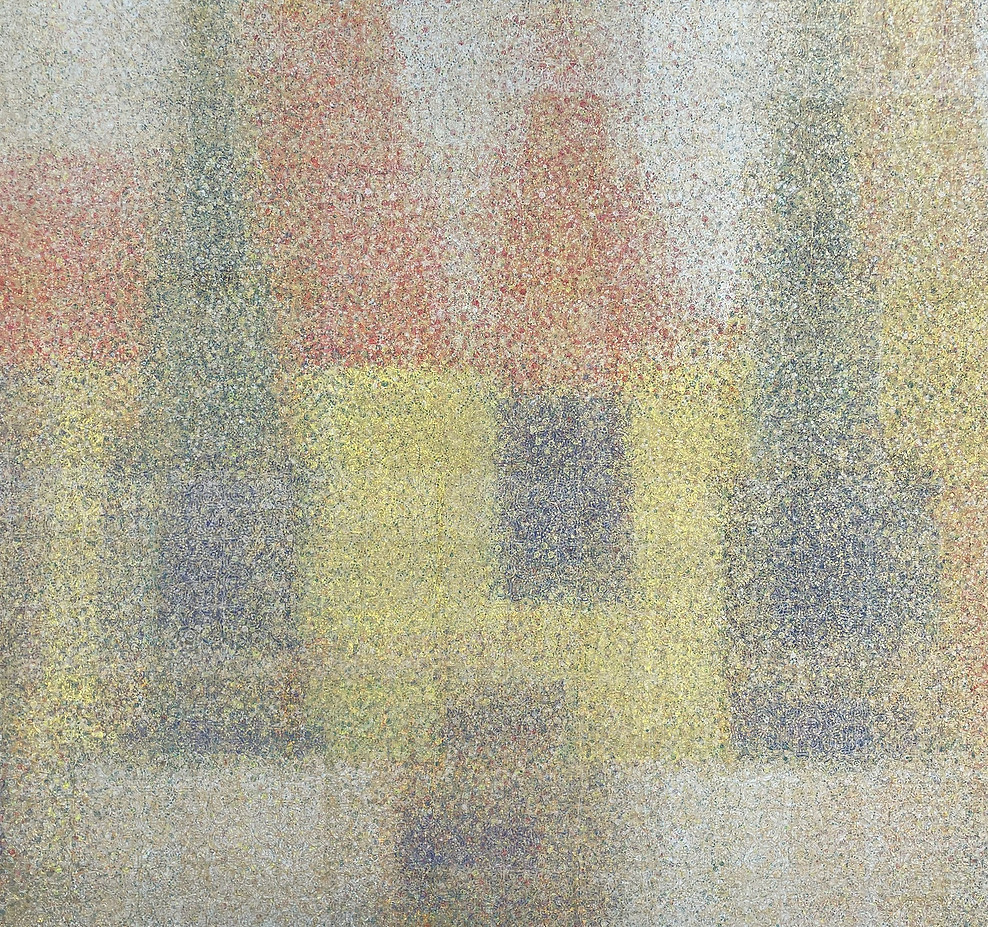
Kiddee — accumulating form Kiddee holds a simple credo: that everything — a tree, a stone, water, and equally a building, a bridge, a car — is born out of the assemblage of minute particles, and that those particles resolve into the simplest geometry there is: the square, the triangle, the circle.
Silkscreen is the exact method for such a belief. One layer, one colour, one shape at a time. As the layers overlap, light begins to rise off the surface, and finally a roofline appears, or the surface of water, or light itself. He too has described nothing. He has only repeated a unit. The world arrives as a by-product of that repetition.
Where the two meet
The two artists meet not through shared subject matter but through shared method.
Buddhist practice preserves two long-standing paths of attention. One follows the breath, one after another — ānāpānasati. The other dissolves phenomena into their smallest irreducible constituents and observes them — the contemplation of elements, dhātu. Khampa carries the first path into painting; Kiddee carries the second into printmaking. One counts time, the other counts form. For both, the act of counting is itself the work.
In the gallery the two surfaces answer each other. Khampa's darkness is slow, monochrome and irreversible, because a breath cannot be taken twice. Kiddee's light is bright, layered and exact, because a screen can always be printed again. One holds time that happens once; the other holds structure that can be repeated. Like night and day, the two surfaces are two hours of the same world.
For the visitor
This exhibition asks for only one practice: count.
Before Khampa's canvases, follow the loops with your eyes, one at a time. Long before you lose count, your breathing will have fallen in beside the painting's. Before Kiddee's works, peel the layers apart, one at a time. Long before you reach the last, the radiance in front of you will have revealed itself as an arrangement of triangles and circles.
Nature is not an object placed before us. It is a state that holds only for as long as attention does. Mindful Nature offers two ways of staying there.
Mindful Nature — a journey to awaken the mind, together with nature.


